
Book Guide
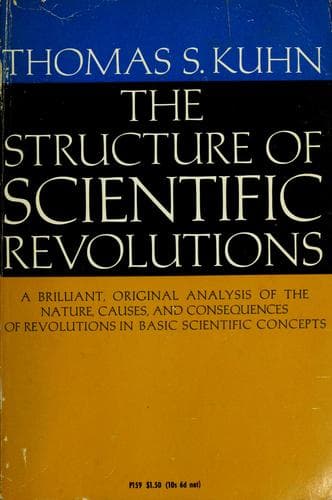
The Structure of Scientific Revolutions
In "The Structure of Scientific Revolutions," Thomas S. Kuhn revolutionizes our understanding of scientific progress by proposing the paradigm shift—a concept that challenges the notion of linear advancement in science. Kuhn highlights that "scientific discovery is not a gradual process" but rather a series of transformative moments that disrupt established frameworks. He elaborates on how normal science operates within existing paradigms, fostering puzzle-solving within accepted norms until anomalies accumulate, prompting a crisis. This culminates in a revolutionary shift, which Kuhn describes as "the replacement of one paradigm by another." He argues that such shifts are not merely the result of accumulating new facts but often involve competitive, subjective interpretations. His work invites readers to reconsider how scientific knowledge is constructed and validated, as it suggests that "the evolution of scientific knowledge is as much a sociological event as it is a logical one." Through a detailed analysis of historical case studies, Kuhn effectively illustrates how the scientific community transitions through periods of "revolutions," ultimately reshaping the landscape of knowledge itself, making this a cornerstone text for anyone seeking to understand the dynamic interplay of science, history, and culture.
Why It Matters
Why readers land on this book
In "The Structure of Scientific Revolutions," Thomas S. Kuhn revolutionizes our understanding of scientific progress by proposing the paradigm shift—a concept that challenges the notion of linear advancement in science. Kuhn highlights that "scientific discovery is not a gradual process" but rather a series of transformative moments that disrupt established frameworks. He elaborates on how normal science operates within existing paradigms, fostering puzzle-solving within accepted norms until anomalies accumulate, prompting a crisis. This culminates in a revolutionary shift, which Kuhn describes as "the replacement of one paradigm by another." He argues that such shifts are not merely the result of accumulating new facts but often involve competitive, subjective interpretations. His work invites readers to reconsider how scientific knowledge is constructed and validated, as it suggests that "the evolution of scientific knowledge is as much a sociological event as it is a logical one." Through a detailed analysis of historical case studies, Kuhn effectively illustrates how the scientific community transitions through periods of "revolutions," ultimately reshaping the landscape of knowledge itself, making this a cornerstone text for anyone seeking to understand the dynamic interplay of science, history, and culture.
Recommendation Proof
Who recommends The Structure of Scientific Revolutions

Highly recommends this book.

Highly recommends this book.

Highly recommends this book.

Highly recommends this book.

Highly recommends this book.

Highly recommends this book.
Read Next
Related books worth exploring







Featured in
Curated Lists
Deep Dive
Articles Mentioning This Book

Quick Answers
The Structure of Scientific Revolutions FAQ
What is The Structure of Scientific Revolutions about?
The Structure of Scientific Revolutions by Thomas S. Kuhn stands out as a high-interest title with strong recommendation value.
Who recommends The Structure of Scientific Revolutions?
The Structure of Scientific Revolutions is highly recommended by Brad Delong, David Deutsch, and Mark Zuckerberg.
Is The Structure of Scientific Revolutions part of a series?
The Structure of Scientific Revolutions is currently treated as a standalone reading destination.
What should I read after The Structure of Scientific Revolutions?
A good next step after The Structure of Scientific Revolutions is The Copernican Revolution, Sapiens, Atlas Shrugged.
When was The Structure of Scientific Revolutions published?
The Structure of Scientific Revolutions was published in 1955.