

The word "science" often evokes traumatic memories of high school biology: memorizing the Krebs cycle, balancing detached chemical equations, and staring blankly at textbook diagrams of cellular mitosis. The education system has a terrifyingly efficient way of making the fundamental mechanics of the universe seem tedious.
But when you examine the reading habits of the world's most aggressive thinkers—billionaire technologists, world-class philosophers, and apex innovators—you consistently find them retreating to the foundational sciences. They don't read these books to pass an exam; they read them because biology, physics, and evolutionary psychology provide the ultimate, irreducible mental models for understanding how systems operate in the real world.
At GurusReads, we have cataloged thousands of book recommendations from verified thought leaders. Our data reveals a stark trend: business and self-help books tend to fade in popularity within a decade, but fundamental science texts remain permanently enshrined at the top of reading lists.
The following books are not dense, impenetrable academic papers. They are magnificent, staggering works of popular science that will permanently alter the resolution at which you view the world. Here are the most heavily recommended science books according to our database of visionaries.
1. The Selfish Gene by Richard Dawkins

When this book was published in 1976, it caused a localized earthquake in the field of evolutionary biology. Before Dawkins, the prevailing theory was that evolution acted upon the organism—that animals evolved traits to ensure their own survival.
Dawkins flipped the magnification. He argued fiercely that the organism doesn't matter. The organism is merely a temporary, disposable "survival machine" built by genes, for the strict benefit of the genes. The genes are the immortal agents calling the shots; your body is just the latest, most advanced robotic vehicle they've constructed to ensure they copy themselves into the next generation.
It is a brutally unsentimental, mechanistic view of life. But it is also a masterclass in incentive structures.
This is exactly why Charlie Munger famously required the executive team at Berkshire Hathaway to read it. It is why Elon Musk frequently citations its profound impact on his worldview. When you understand that complex, seemingly altruistic behavior in nature can arise purely from completely selfish, microscopic incentives, you instantly understand how to structure compensation packages, corporate hierarchies, and software platforms.
Dawkins didn't just write a book about biology; he wrote the ultimate textbook on game theory. It remains one of the most cited books across the entire GurusReads platform, recommended heavily by Bill Gates, Mark Zuckerberg, and Paul Graham.
2. Sapiens: A Brief History of Humankind by Yuval Noah Harari
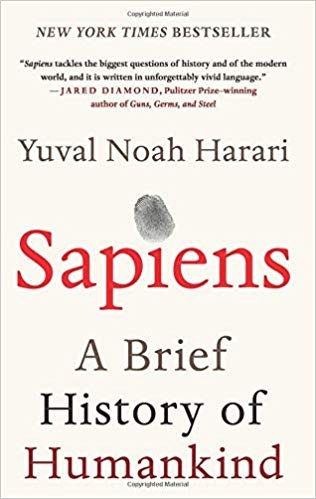
While anthropologists debate the nuances of its academic rigor, there is absolutely no denying the staggering cultural footprint of Harari's Sapiens. Rarely does a book manage to completely reframe the overarching narrative of the human species in just 450 pages.
Harari's core thesis is that Homo sapiens conquered the globe not because we were the strongest or the smartest hominids, but because we possess a unique biological mutation: the ability to believe in shared fictions. We can create abstract concepts that don't physically exist—like the idea of a corporation, the concept of a nation-state, human rights, or fiat currency—and use those fictions to cooperate in massive, flexible numbers. A chimpanzee cannot be convinced to give you a banana today in exchange for limitless bananas in monkey heaven after they die; only Sapiens can play this game.
Barack Obama famously recommended it, noting its sweeping historical perspective. The book is practically mandatory reading in Silicon Valley, where founders are essentially in the business of manifesting "shared fictions" (startups) out of thin air and convincing venture capitalists and engineers to believe in them.
Harari's work is a breathtaking synthesis of biology, history, and economics. It is recommended across our database by Naval Ravikant, Ray Dalio, and Arianna Huffington.
3. Cosmos by Carl Sagan

Before Neil deGrasse Tyson, and before the modern explosion of pop-science YouTube channels, there was Carl Sagan. Sagan possessed an astonishingly rare gift: he could speak about astrophysics and orbital mechanics with the cadence and reverence of a poet.
Cosmos is ostensibly a book about the universe—galaxies, stars, the origin of life, and the vast, unfeeling vacuum of space. But in reality, it is a profound philosophical meditation on humility. In Sagan's view, humans are literally "star stuff"—heavy elements forged in the core of collapsing supernovas that somehow woke up and achieved consciousness.
For high-performing individuals caught in the petty, stressful minutiae of daily operations, Cosmos provides an immediate, jarring dose of perspective. It shrinks global politics, quarterly earnings, and social media outrage into insignificance against the scale of geologic time.
Sagan's ability to incite radical awe makes this a staple on the bookshelves of people like Neil deGrasse Tyson himself, Tim Ferriss, and legendary game designer Hideo Kojima.
4. A Brief History of Time by Stephen Hawking

It is notoriously known as "the most unread book of all time," a title earned because millions of people bought it to look smart and promptly abandoned it at chapter three when the geometry of black holes became difficult to track.
However, for those who actually push through it, Hawking's masterpiece remains one of the most accessible gateways into the bizarre, terrifying world of quantum mechanics and general relativity. Hawking managed to explain the mechanics of the Big Bang, the arrow of time, and string theory using exactly one mathematical equation throughout the entire book: $E = mc^2$.
Founders and engineers revere this book because it forces the brain to conceptualize problems outside of human intuition. Newtonian physics makes sense to our primate brains; quantum mechanics and the bending of spacetime absolutely do not. To understand Hawking's universe, you have to abandon common sense and trust the math—a mental leap that proves invaluable when attempting to build disruptive technologies.
It is heavily cited by Elon Musk and Jeff Bezos.
5. The Structure of Scientific Revolutions by Thomas S. Kuhn

This is the book that gave the world the phrase "paradigm shift."
Thomas Kuhn fundamentally destroyed the naive idea that science is a linear, steady accumulation of objective truths. Instead, he argued that science operates in long periods of "normal science" where everyone agrees on the current rules, inevitably followed by a sudden, violent disruption—a scientific revolution—where the old model collapses and a new paradigm is forced into reality.
Understanding this cycle of equilibrium and sudden disruption is the holy grail of venture capitalism. Every major investor in Silicon Valley reads Kuhn because the mechanics of a scientific revolution map perfectly onto the mechanics of technological disruption. The transition from Ptolemaic astronomy to Copernican astronomy is mechanically identical to the transition from physical retail to e-commerce, or from internal combustion engines to electric vehicles.
Marc Andreessen considers it mandatory reading for understanding how the world actually changes. It is also recommended broadly by Peter Thiel and Chamath Palihapitiya.
If you find yourself stuck in a rut of repetitive business frameworks, the highest-leverage thing you can do is switch genres and start reading physics and evolutionary biology. You can explore exactly what scientific literature the world's most successful people are reading next on GurusReads.