
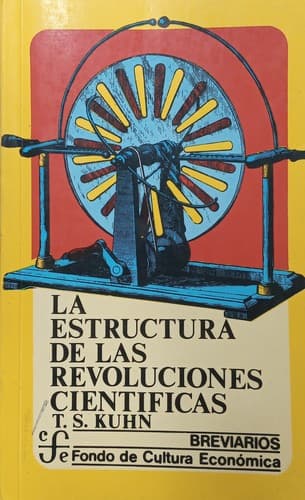
Guía del Libro
La estructura de las revoluciones científicas
In "The Structure of Scientific Revolutions," Thomas S. Kuhn revolutionizes our understanding of scientific progress by proposing the paradigm shift—a concept that challenges the notion of linear advancement in science. Kuhn highlights that "scientific discovery is not a gradual process" but rather a series of transformative moments that disrupt established frameworks. He elaborates on how normal science operates within existing paradigms, fostering puzzle-solving within accepted norms until anomalies accumulate, prompting a crisis. This culminates in a revolutionary shift, which Kuhn describes as "the replacement of one paradigm by another." He argues that such shifts are not merely the result of accumulating new facts but often involve competitive, subjective interpretations. His work invites readers to reconsider how scientific knowledge is constructed and validated, as it suggests that "the evolution of scientific knowledge is as much a sociological event as it is a logical one." Through a detailed analysis of historical case studies, Kuhn effectively illustrates how the scientific community transitions through periods of "revolutions," ultimately reshaping the landscape of knowledge itself, making this a cornerstone text for anyone seeking to understand the dynamic interplay of science, history, and culture.
Por qué es importante
Por qué los lectores eligen este libro
In "The Structure of Scientific Revolutions," Thomas S. Kuhn revolutionizes our understanding of scientific progress by proposing the paradigm shift—a concept that challenges the notion of linear advancement in science. Kuhn highlights that "scientific discovery is not a gradual process" but rather a series of transformative moments that disrupt established frameworks. He elaborates on how normal science operates within existing paradigms, fostering puzzle-solving within accepted norms until anomalies accumulate, prompting a crisis. This culminates in a revolutionary shift, which Kuhn describes as "the replacement of one paradigm by another." He argues that such shifts are not merely the result of accumulating new facts but often involve competitive, subjective interpretations. His work invites readers to reconsider how scientific knowledge is constructed and validated, as it suggests that "the evolution of scientific knowledge is as much a sociological event as it is a logical one." Through a detailed analysis of historical case studies, Kuhn effectively illustrates how the scientific community transitions through periods of "revolutions," ultimately reshaping the landscape of knowledge itself, making this a cornerstone text for anyone seeking to understand the dynamic interplay of science, history, and culture.
Prueba de Recomendación
Quién recomienda The Structure of Scientific Revolutions

Recomienda encarecidamente este libro.

Recomienda encarecidamente este libro.

Recomienda encarecidamente este libro.

Recomienda encarecidamente este libro.

Recomienda encarecidamente este libro.

Recomienda encarecidamente este libro.
Leer a continuación
Libros relacionados para explorar







Presentado en
Listas Temáticas
Deep Dive
Articles Mentioning This Book

Respuestas Rápidas
Preguntas Frecuentes sobre The Structure of Scientific Revolutions
¿De qué trata The Structure of Scientific Revolutions?
The Structure of Scientific Revolutions por Thomas S. Kuhn se destaca como un título de gran interés con fuerte valor de recomendación.
¿Quién recomienda The Structure of Scientific Revolutions?
The Structure of Scientific Revolutions es altamente recomendado por Brad Delong, David Deutsch, and Mark Zuckerberg.
¿The Structure of Scientific Revolutions es parte de una serie?
The Structure of Scientific Revolutions es una lectura independiente destacada.
¿Qué debo leer después de The Structure of Scientific Revolutions?
Un buen siguiente paso después de The Structure of Scientific Revolutions es The Copernican Revolution, Sapiens, Atlas Shrugged.
¿Cuándo se publicó The Structure of Scientific Revolutions?
Los datos del año de publicación para The Structure of Scientific Revolutions actualmente no están completos en la base de datos.